Beginner Cooking Guide: Easy Cooking Techniques and Meal Preparation Ideas
Introduction
Learning to cook is less about fancy recipes and more about building a small set of reliable habits. When you understand how heat changes food, how to prep ingredients before the pan gets hot, and how to plan a few meals ahead, weeknight cooking becomes faster, cheaper, and far less stressful. This guide matters for students, busy workers, new parents, and anyone tired of takeout because it turns basic kitchen skills into routines that fit real life.
For beginners, the kitchen can feel like a room full of tiny decisions: how hot should the pan be, when should you add salt, why do some vegetables turn sweet in the oven while others go soft in water, and how do you make enough food without eating the same bland leftovers for days. The good news is that cooking is a learnable system. Once you grasp a handful of easy techniques and pair them with smart meal preparation, your confidence rises quickly. Instead of treating every dinner like a test, you begin to see patterns. A pot, a pan, a tray, and a few ingredients can suddenly feel like a toolkit rather than a puzzle.
Outline
This article is organized in five parts. First, it explains the core techniques every beginner should practice, including knife work, heat control, seasoning, and doneness. Second, it compares easy cooking methods such as boiling, sautéing, roasting, steaming, and one-pan cooking so you can choose the right approach for different ingredients. Third, it explores meal preparation ideas, from batch cooking to component prep and storage. Fourth, it covers kitchen workflow, shopping, pantry planning, and food safety. Fifth, it shows how to build simple meal formulas that help you cook without relying on a strict recipe every night.
1. The Core Skills Every Beginner Should Learn First
Before buying specialized tools or bookmarking dozens of recipes, it helps to focus on the mechanics that make cooking work. Think of these as the alphabet of the kitchen. Once you know the letters, you can read almost any recipe with less friction. The most useful beginner skills are knife handling, heat control, seasoning, and timing. None of them require advanced talent. They require repetition, attention, and a little patience.
Knife skills matter because even cuts help food cook evenly. If one carrot slice is thick and the next is paper-thin, the small piece may burn before the large one softens. Beginners do not need decorative cuts. They need safe, consistent ones. Start with simple shapes: slices, strips, and small cubes. A sharp knife is safer than a dull one because it is less likely to slip. Keep your fingertips tucked inward when holding food, and let the knife do the work instead of forcing it through the ingredient.
Heat control is where many new cooks either rush or hesitate. High heat is not automatically better. Sautéing vegetables often works well over medium to medium-high heat because it encourages browning without scorching. Simmering, unlike boiling, is gentler and better for soups, beans, and sauces that need time. Water boils at 212°F or 100°C at sea level, while a simmer happens below that point, often around 185°F to 205°F. Learning to spot the visual difference between a furious boil and a soft bubble is more useful than memorizing numbers alone.
Seasoning is not only about salt, although salt is central. Salt helps food taste more like itself. Add a small amount early to onions or vegetables and you draw out moisture; add more near the end and you sharpen flavor. Acid, such as lemon juice or vinegar, brightens heavy dishes. Fat, from olive oil, butter, or yogurt, adds richness and carries flavor. Herbs and spices change mood: cumin brings warmth, dill feels fresh, paprika adds sweetness or smoke depending on the type. Taste as you go, especially with soups, grains, dressings, and sauces.
Timing is the invisible thread that holds dinner together. Ingredients rarely cook at the same speed, so beginners should learn sequencing. Start items that take longest first, such as rice, potatoes, or roasted vegetables. Quick ingredients, such as spinach, shrimp, or eggs, can wait until later. Food safety also belongs here. The USDA recommends cooking poultry to 165°F or 74°C, ground meats to 160°F or 71°C, and whole cuts of beef, pork, veal, and lamb to 145°F or 63°C followed by a rest. Even if you do not own a thermometer yet, understanding doneness matters.
A few beginner priorities are worth posting on the fridge:
– Read the recipe once before starting.
– Prep ingredients before heating the pan.
– Keep the sink and counter clear enough to work.
– Taste before serving.
– Accept that the first version does not need to be perfect.
That last point matters. Cooking skill grows quietly. One evening, onions brown more evenly. Another day, rice finally comes out fluffy. Then, almost without ceremony, the kitchen stops feeling like a stage and starts feeling like home.
2. Easy Cooking Techniques Compared: What to Use and When
Beginners often ask the same practical question: what is the easiest way to cook this ingredient well? The answer depends on the texture, flavor, and time you want. Five methods cover most beginner needs: boiling, steaming, sautéing, roasting, and one-pan or one-pot cooking. Each method has strengths, trade-offs, and ideal uses. Understanding those differences makes weeknight decisions much simpler.
Boiling is one of the fastest and most familiar methods. It works well for pasta, potatoes, eggs, and some vegetables. The advantage is speed and predictability. Pasta follows clear timing, potatoes soften reliably, and hard-boiled eggs are easy to batch. The downside is that boiling can mute flavor if ingredients stay in water too long. Green beans boiled past their prime become dull instead of bright. For that reason, boiling is often best for foods meant to absorb seasoning later, such as pasta that will meet sauce, or potatoes destined for a mash or salad.
Steaming is gentler. Instead of immersing food in water, you cook it with moist heat above simmering liquid. This helps vegetables keep shape and color better than boiling. Broccoli, carrots, dumplings, and fish can all benefit from steaming. It does not create the browning that gives roasted food a deeper flavor, but it preserves a clean, fresh taste. If you want tender vegetables with little added fat, steaming is a strong option.
Sautéing is the method that teaches awareness. Small pieces of food cook in a lightly oiled pan over moderate to fairly high heat. You stir, watch, listen, and smell. Onions become sweet, mushrooms release moisture, zucchini picks up color, and chicken pieces can cook quickly when cut evenly. Compared with boiling or steaming, sautéing gives better browning and richer flavor. It demands a little more attention, but the payoff is immediate. Crowding the pan is the main beginner mistake. Too much food lowers the pan temperature and creates steam instead of browning.
Roasting is the quiet workhorse of easy cooking. Put vegetables, chicken thighs, or salmon on a tray, season them, and let the oven handle much of the effort. Roasting at around 400°F to 425°F, or 200°C to 220°C, encourages caramelization, which is why carrots become sweeter and Brussels sprouts develop crisp edges. Compared with sautéing, roasting asks for less hands-on attention. Compared with steaming, it creates fuller flavor. The main trade-off is time, since preheating and oven cooking usually take longer.
One-pan and one-pot cooking deserve special mention because they are ideal for new cooks who want fewer dishes and simpler timing. A sheet-pan dinner might combine chicken, onions, peppers, and potatoes. A one-pot meal could be soup, chili, lentils, or rice with vegetables. The flavor may be less layered than a multi-step restaurant dish, but the convenience is excellent.
A quick comparison helps:
– Boiling: fast, practical, best for pasta, potatoes, eggs, and some vegetables.
– Steaming: gentle, clean tasting, best for vegetables, fish, and dumplings.
– Sautéing: flavorful, quick, best for cut vegetables, eggs, chicken strips, and stir-fries.
– Roasting: deep flavor, hands-off, best for vegetables, chicken, fish, and tray bakes.
– One-pot or one-pan: easiest cleanup, strong for busy nights and batch meals.
When in doubt, ask yourself three things: Do I want browning, do I need speed, and how much cleanup can I tolerate tonight? Those answers usually point to the right method faster than any complicated rule book.
3. Meal Preparation Ideas That Save Time Without Killing Variety
Meal prep sounds efficient, but many beginners abandon it because they imagine spending half of Sunday filling identical containers with joyless chicken and rice. That is only one version of it, and for many people it is not the best one. A smarter approach is to treat meal preparation as a menu of options: full meal prep, component prep, batch cooking, and ingredient-ready prep. The most sustainable system is the one that matches your schedule, appetite, and tolerance for repetition.
Full meal prep means cooking complete dishes in advance and portioning them for later. This works well for lunches, especially for people with fixed work hours. Grain bowls, stews, pasta bakes, curries, soups, and roasted vegetable trays all hold up well. The benefit is convenience. You open the refrigerator and dinner is nearly done. The drawback is boredom. Eating the same lunch four days in a row can make even good food feel flat.
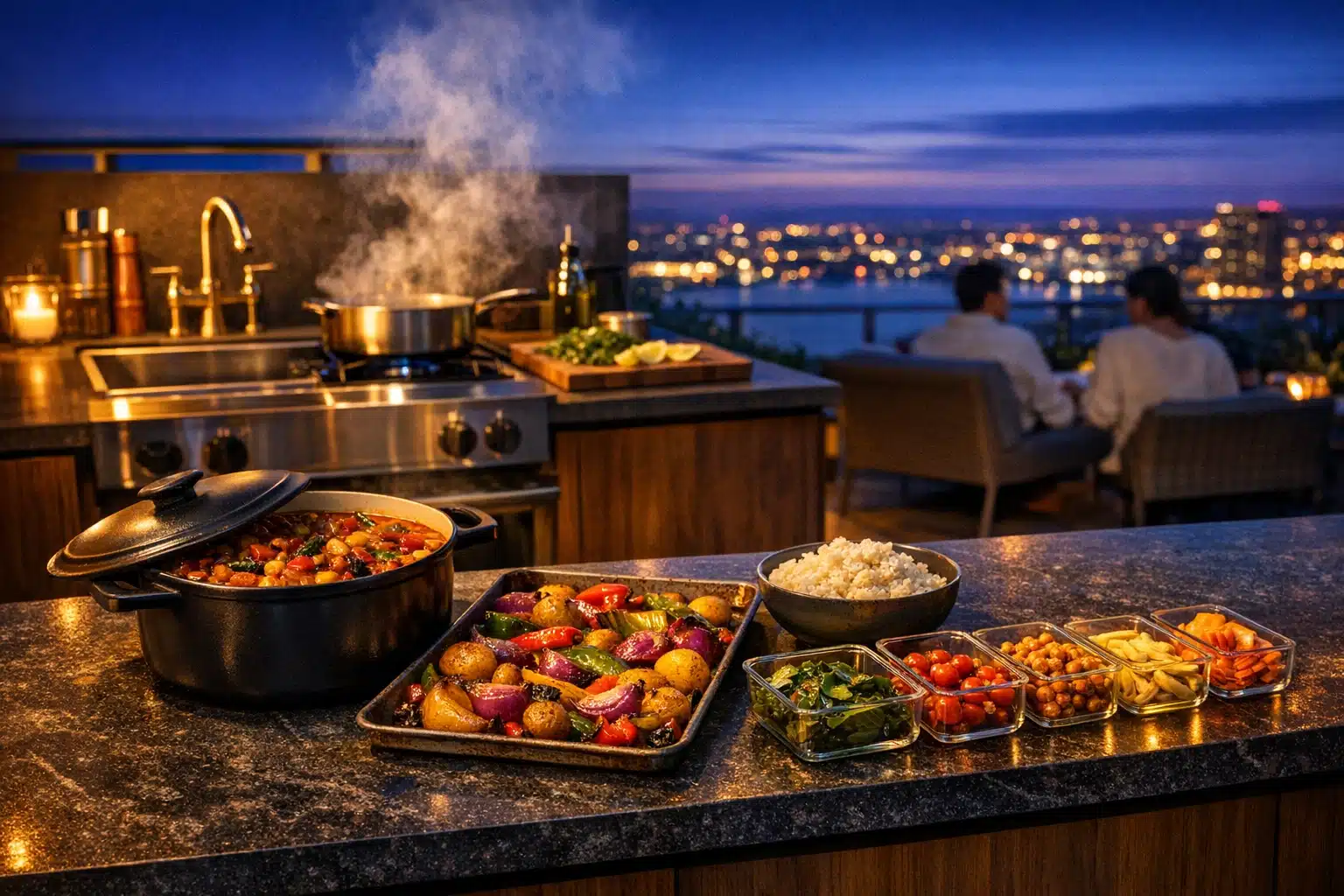
Component prep is often better for beginners. Instead of preparing four finished meals, you cook pieces that can be mixed in different ways. For example, make a pot of rice, roast a tray of vegetables, wash greens, boil eggs, and cook a batch of beans or chicken. From those parts, you can assemble grain bowls one day, wraps the next, soup the day after, and a quick fried rice at the end of the week. This method reduces waste and increases flexibility. It also lets you season meals differently so they do not all taste alike.
Batch cooking is useful for foods that freeze well or improve after resting. Chili, lentil soup, tomato sauce, and meatballs are classic examples. Cooking a larger quantity is usually more efficient than making tiny nightly portions. A pot is already hot, the onions are already chopped, and the cleanup is roughly the same. If you freeze in small containers, you create your own emergency meals. It is the culinary equivalent of leaving future-you a thoughtful note.
Safe storage is essential. Keep the refrigerator at 40°F or 4°C or below. Per USDA guidance, most cooked leftovers are best used within 3 to 4 days. Refrigerate food within 2 hours, or within 1 hour if the room is very hot. Shallow containers cool faster than deep ones, which helps both food quality and safety. Labeling containers with a date is simple, and it saves the classic “How long has this been here?” debate.
Useful prep ideas for a typical week include:
– Wash and dry lettuce, herbs, and cucumbers for quick salads.
– Roast a large tray of mixed vegetables for bowls, sandwiches, and side dishes.
– Cook one grain such as rice, farro, or quinoa.
– Prepare one protein such as baked tofu, shredded chicken, beans, or boiled eggs.
– Mix one sauce or dressing, like yogurt herb sauce, vinaigrette, or peanut dressing.
Another important comparison is big-prep day versus mini-prep sessions. One long session can be efficient, but it may feel exhausting. Two shorter sessions, such as Sunday and Wednesday, often keep ingredients fresher and reduce monotony. If your week is unpredictable, mini-prep usually wins. If your weekdays are packed, a larger weekend session may work better.
The real goal is not to become a meal-prep machine. It is to create enough structure that cooking feels easier on ordinary days. When the fridge contains a few ready ingredients, dinner stops being a hurdle and starts becoming assembly with benefits.
4. Kitchen Workflow, Shopping Strategy, and Food Safety for New Cooks
A lot of cooking frustration happens before the stove is even turned on. You get home hungry, discover there is no onion, realize the cutting board is buried, and suddenly a simple meal feels impossible. Good kitchen workflow solves this. Professional cooks call part of this system mise en place, a French term that means putting everything in place. For beginners, that idea is less about formality and more about reducing chaos.
Start with shopping. A beginner-friendly grocery strategy is to buy a mix of staples, flexible produce, and one or two proteins. Staples keep the kitchen functional. Flexible produce gives you options. Proteins anchor meals. A small pantry supports far more dinners than people expect. You do not need twenty sauces and a shelf of obscure grains. You need ingredients that can appear in multiple combinations.
A practical starter pantry might include:
– Rice or pasta
– Canned beans and canned tomatoes
– Eggs
– Onions and garlic
– Olive oil or another neutral cooking oil
– Salt and black pepper
– One acid, such as vinegar or lemon
– Two or three spices you actually enjoy
– Frozen vegetables for backup meals
Once you are home, read the recipe or plan once from start to finish. Then gather ingredients, wash produce, and do your chopping before heating the pan when possible. This is especially useful for sautéing, stir-frying, and any quick stovetop method. New cooks often start cooking first and cutting later, which can lead to burned garlic, overcooked onions, or frantic multitasking. Prep creates breathing room.
Kitchen workflow also improves with sequencing. Put water on to boil before you chop salad ingredients. Start oven dishes first because they take longer. While rice cooks, prepare sauce or slice vegetables. Try to stack tasks rather than waiting passively. Cooking feels much easier when one action supports the next.
Food safety should sit quietly in the background like a dependable stage manager. It does not need to be dramatic, but it must be consistent. Keep raw meat separate from ready-to-eat foods. Wash hands after handling raw poultry, meat, or eggs. Use clean utensils and boards, especially if one surface touched raw protein. The food safety “danger zone” is 40°F to 140°F, or 4°C to 60°C, where bacteria can multiply quickly. That is why cooling, refrigeration, and reheating matter.
Beginners also benefit from knowing the difference between tidy and sterile. A functional kitchen does not have to look like a showroom. It should simply be workable. A clear counter, a clean knife, a dry towel, and a place to set scraps make cooking smoother. Keep a bowl nearby for peels and trimmings. Wash as you go when there is downtime. Even five small cleanup moments can prevent a giant sink disaster later.
Here are a few common problems and better responses:
– Problem: Buying ingredients for one recipe only. Better response: Choose items that can be used in at least two meals.
– Problem: Cooking when extremely hungry. Better response: Eat a small snack first so you can think clearly.
– Problem: Overcrowding the refrigerator with random leftovers. Better response: Store food in visible, labeled containers.
– Problem: Giving up after one mediocre result. Better response: Change one variable next time instead of abandoning the dish.
If cooking is a performance, workflow is the rehearsal. It is not glamorous, but it is why the final act lands with confidence instead of confusion.
5. Simple Meal Formulas Beginners Can Use Again and Again
One of the fastest ways to become a more capable cook is to stop treating every meal as an isolated event. Recipes are helpful, especially at first, but formulas are what build independence. A formula is a repeatable structure: protein plus vegetable plus starch plus sauce, or aromatics plus liquid plus grain plus finish. Once you learn a few of these frameworks, you can cook with what you have instead of feeling stuck when one ingredient is missing.
The grain bowl is one of the easiest starter formulas. Begin with a base such as rice, quinoa, couscous, or farro. Add a protein like beans, tofu, chicken, tuna, or a fried egg. Include vegetables, either roasted, raw, steamed, or sautéed. Finish with a sauce or dressing and something crunchy if you have it, such as seeds, nuts, or toasted breadcrumbs. The beauty of this structure is flexibility. It works for lunch, dinner, leftovers, and packed meals. It also teaches balance: soft, crisp, rich, bright, warm, and cool can all share one bowl.
Another reliable formula is the sheet-pan dinner. Choose ingredients that roast in roughly similar time frames or stagger them. For example, potatoes may need a head start before adding broccoli or fish. Toss everything lightly with oil, salt, and seasoning, then roast until cooked through. This is one of the easiest methods for beginners because the oven does much of the timing work. It also rewards experimentation. Italian seasoning, curry powder, smoked paprika, garlic, and lemon can all transform the same basic tray.
Soup is another beginner-friendly framework because it tolerates imperfection well. Start with aromatics such as onion, carrot, celery, or garlic. Add oil, then a liquid such as water, broth, or canned tomatoes plus water. Include vegetables, beans, lentils, pasta, or shredded chicken. Simmer until everything is tender. Finish with herbs, acid, cheese, yogurt, or olive oil. Soup teaches layering: some ingredients go in early for depth, while delicate items like spinach or herbs belong near the end.
For very fast nights, keep a stir-fry or skillet formula in mind. Heat oil, cook protein if using, remove if needed, then cook firm vegetables first and tender ones later. Add sauce at the end and serve over rice or noodles. The comparison with roasting is useful here: stir-frying is faster and more hands-on, while roasting is slower and more hands-off. Choose based on your energy, not on some abstract idea of what a “better” cook would do.
Breakfast can be formula-driven too:
– Oats plus fruit plus nuts plus yogurt
– Eggs plus toast plus greens
– Smoothie with fruit, milk or yogurt, oats, and nut butter
– Leftover rice plus egg plus vegetables for a savory bowl
The final lesson is adaptation. If a recipe asks for spinach and you have kale, use kale with a longer cooking time. If you lack fresh garlic, use onion and herbs. If you have no chicken, choose beans or eggs. Substitution becomes easier when you understand the role an ingredient plays. Is it there for freshness, richness, acidity, sweetness, heat, or body? Once you answer that, alternatives become visible.
That is when cooking gets fun. The kitchen no longer asks, “Can you follow directions?” It begins to ask, “What can you make from what you know?” For a beginner, that shift is huge. It turns cooking from a rigid script into a flexible language you can actually speak.
Conclusion for Beginner Home Cooks
If you are new to cooking, the most useful goal is not perfection but repeatability. Learn a few dependable techniques, compare methods based on texture and time, prep ingredients in ways that suit your week, and keep your workflow simple enough to follow on tired evenings. A sharp knife, a hot pan used correctly, a short grocery list, and two or three meal formulas can carry you much further than complicated recipes ever will. Start small, cook often, and let confidence build through ordinary meals. The more you practice these basics, the more natural cooking becomes, and that is when homemade food begins to feel less like work and more like a quiet advantage you can use every day.