Home Decor Ideas for a Stylish and Comfortable Living Space
Home decor shapes more than appearance; it influences mood, comfort, focus, and the way a room supports daily life. Thoughtful decoration can make a compact apartment feel open, help a busy family stay organized, and turn an unused corner into a place that invites rest. Because homes now serve as offices, classrooms, and retreats, interior decor has become a practical tool as much as a visual one. The ideas ahead show how style and function can work together.
Outline and Core Principles of Home Decor
Before choosing paint colors or shopping for cushions, it helps to understand what home decoration is really trying to achieve. Good interior decor is not a contest in trend-following, and it is not simply about filling empty walls. At its best, it solves problems. It can make a narrow room feel less cramped, help a family room stay usable, improve visual harmony, and reflect the habits of the people who live there. A stylish space usually feels intentional, but the most successful homes also feel lived in, practical, and deeply personal.
Article roadmap:
• First, define the purpose of the room and the lifestyle it needs to support.
• Next, build the visual foundation with color, lighting, and proportion.
• Then, choose furniture and layouts that improve comfort and movement.
• After that, layer texture, accessories, and art to create personality.
• Finally, make thoughtful budget decisions so the result looks complete rather than random.
This order matters. Many decorating mistakes happen when people buy attractive objects before making a plan. A sofa may look perfect in a showroom and completely overwhelm a small living room at home. A dramatic wall color may feel sophisticated in a magazine but heavy in a dim apartment. Decoration works best when decisions are connected. Designers often begin by asking simple questions: Who uses the room? What activities happen there? What must stay? What is missing? Those answers shape every later choice.
There is also a growing body of evidence from environmental psychology showing that surroundings affect well-being. Cluttered, visually noisy rooms are often associated with higher perceived stress, while organized spaces tend to support concentration and calm. That does not mean every home should look minimalist. A maximalist interior can still feel peaceful if the arrangement is deliberate, storage is effective, and colors relate to one another. Think of decor as choreography. Every piece has a role, every surface has a rhythm, and every empty area matters as much as the objects placed inside it.
One useful comparison is minimalism versus layered decorating. Minimalist rooms rely on fewer items, cleaner lines, and negative space to create calm. Layered rooms use textiles, books, artwork, and collected objects to create richness and warmth. Neither approach is automatically better. The right choice depends on maintenance habits, household size, architecture, and taste. A family with young children may prefer durable fabrics and hidden storage over fragile decor. A renter may choose lighting, art, and textiles as flexible upgrades. A homeowner renovating from scratch may invest earlier in flooring, built-ins, and architectural details. Once the purpose is clear, decor becomes much easier to shape.
Color, Light, and Visual Balance: The Foundation of Interior Decor
Color and light form the emotional climate of a room. Before a visitor notices the brand of the chair or the shape of a coffee table, they respond to atmosphere. Warm neutrals can make a space feel relaxed and grounded. Crisp whites can feel clean and airy. Deep blues, olive greens, terracotta tones, and charcoal shades can add character, but they need to be balanced with light, texture, and scale. Choosing color is less about finding a universally attractive shade and more about selecting tones that behave well in the room’s actual conditions.
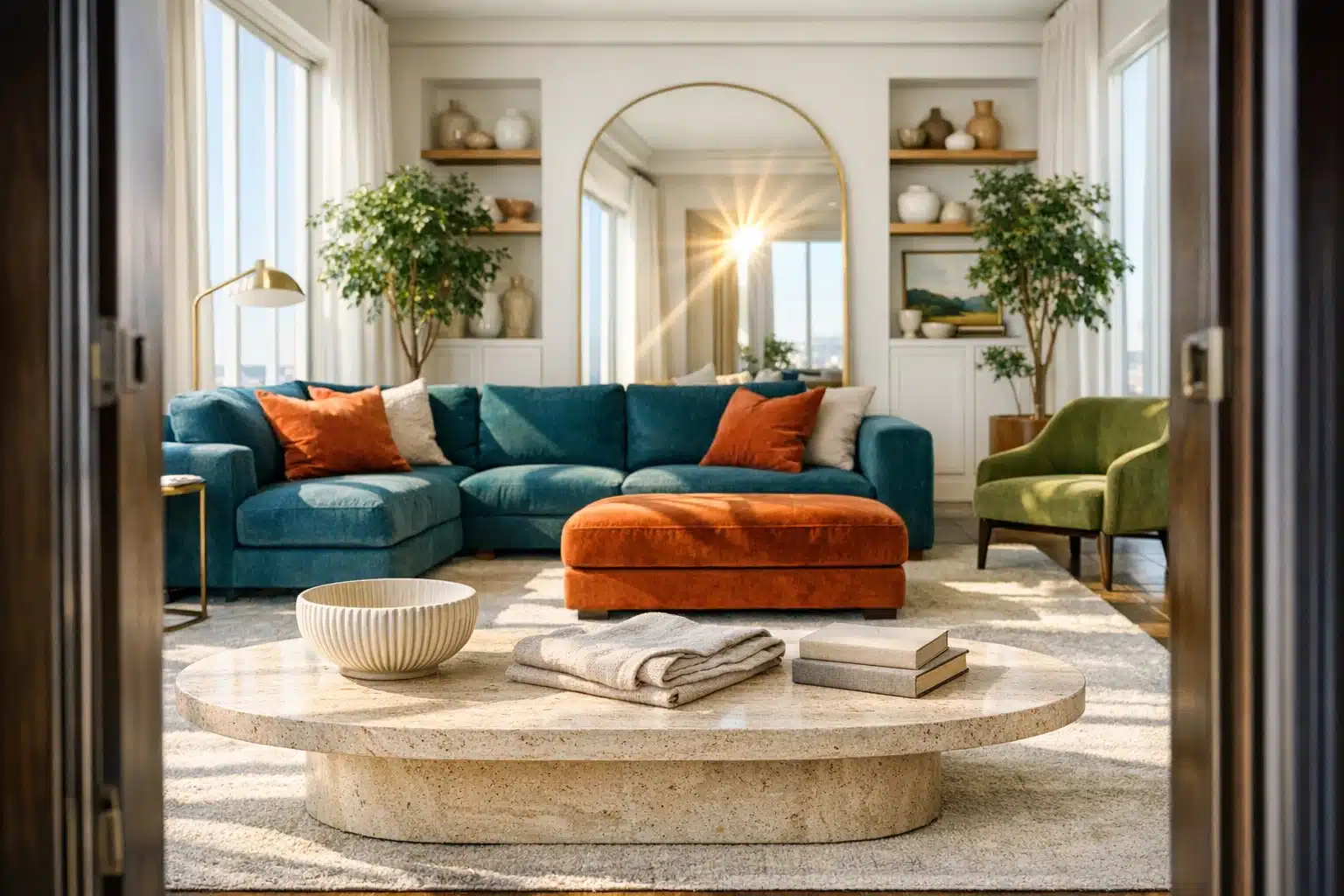
A useful guideline is the classic 60-30-10 rule. Around 60 percent of the room carries the main color, often through walls, large rugs, or a dominant sofa. Roughly 30 percent is a secondary color, which may appear in curtains, bedding, accent chairs, or cabinetry. The final 10 percent acts as a sharper accent through art, cushions, ceramics, or decorative objects. This rule is not mandatory, but it helps prevent the common problem of a room feeling scattered. It also supports comparison. A neutral room with one bold accent color often feels calm and modern, while a palette with several competing bright tones can feel energetic but visually busier.
Lighting is just as important as color selection, because the same paint can look entirely different in morning sun, afternoon shadow, or warm lamplight. Natural light tends to make rooms feel more spacious, and lighter wall finishes reflect it more effectively. Artificial lighting should be layered rather than singular. A single ceiling fixture often creates flat illumination and harsh shadows. A better approach combines ambient light for general brightness, task light for reading or work, and accent light for mood. In many living spaces, bulbs in the 2700K to 3000K range create a comfortable glow, while kitchens and work zones can benefit from slightly cooler temperatures for clarity.
Practical decisions can dramatically improve balance:
• Use mirrors to bounce daylight deeper into a room.
• Keep large, dark furniture away from the only window when possible.
• Repeat colors at least two or three times so accents feel intentional.
• Mix matte and reflective finishes to avoid a lifeless or overly glossy result.
There is also the question of contrast. High-contrast rooms, such as black-and-white schemes, can feel sharp and graphic. Tonal rooms, built from shades of cream, stone, taupe, or gray, create a softer effect and often age well. If a room feels flat, the answer is not always more color. Sometimes it needs better lighting, stronger shadow lines, or a more thoughtful mix of textures. A room should greet you, not glare at you, and that gentle balance is where effective home decoration begins.
Furniture, Layout, and Flow: Making a Room Work as Well as It Looks
Furniture is where style meets daily behavior. A beautiful room quickly loses appeal if people cannot move through it comfortably, reach a table easily, or use storage without frustration. Layout determines whether a home feels generous or awkward, spacious or cramped, sociable or disconnected. For that reason, experienced decorators often measure first and shop later. Scale is not a minor technical detail; it is the difference between a living room that invites conversation and one that feels like a storage unit for expensive objects.
One of the most reliable layout rules is to preserve clear circulation. In many homes, leaving about 30 to 36 inches for primary walkways helps movement feel natural, though tighter spaces can sometimes function with slightly less. Coffee tables usually work best when placed around 14 to 18 inches from the sofa, close enough to be useful without blocking knees or foot traffic. Dining chairs need pull-out room, bedside tables should sit near mattress height, and rugs should anchor furniture rather than float in isolation. A rug that is too small can make an otherwise attractive room feel underfurnished and disconnected.
Furniture arrangement also changes how a room is used. In an open-plan space, rugs, lighting, and seating groupings can define separate zones for reading, dining, or conversation without adding walls. In smaller rooms, multi-functional pieces become especially valuable. A storage ottoman can hide blankets, a bench can work as seating and display, and a drop-leaf table can expand when guests arrive. Comparing a minimalist layout with a crowded one shows why restraint matters. Fewer, better-sized pieces often make a room feel more luxurious than many undersized items trying to do the same job.
Useful layout checkpoints:
• Let the front legs of major seating pieces sit on the rug when possible.
• Match sofa depth to the way the room is actually used; lounging and formal sitting are not the same.
• Avoid pushing every piece against the wall if the room is large enough for a conversation area.
• Leave surfaces for real life, not only decoration, especially near seating and entry points.
Comfort should guide style choices. A sculptural chair may look elegant online and feel impossible to relax in for more than ten minutes. A low-profile sofa may suit a modern aesthetic but frustrate older adults who need easier support. Families with children or pets often benefit from performance fabrics, washable slipcovers, and rounded edges. In that sense, interior decor is not a still photograph; it is an operating system for the household. The best rooms understand how mornings begin, how evenings slow down, where bags land, where books pile up, and where people naturally gather. When the layout respects those habits, a home starts to feel effortlessly functional.
Texture, Accessories, and Personality: Turning a House into a Living Space
Once color and furniture are in place, many rooms still feel unfinished. This usually has less to do with cost than with layering. Texture gives a room depth, softness, and emotional warmth. Accessories tell the story of who lives there. Without them, even an expensive interior can feel flat, like a stage set waiting for actors. With them, a room gains rhythm and memory. The goal is not clutter. The goal is character.
Texture can come from almost anything: a woven rug, linen curtains, boucle upholstery, polished wood, brushed metal, stone, ceramic, leather, or a chunky knit throw. Mixing these surfaces creates contrast that the eye enjoys. A room full of smooth finishes often feels cold. A room full of heavy textures can feel visually dense. Balance is what matters. Compare a sleek modern room with a rustic one. The modern space often relies on sharp edges, restrained palettes, and a smaller number of carefully chosen objects. The rustic or collected look layers natural materials, patina, handmade pieces, and warmer variation. Both can succeed if the textures support the intended mood.
Accessories deserve the same discipline as furniture. Art should relate to wall size and sight lines. Small frames scattered too far apart can look accidental, while one properly scaled piece can anchor an entire room. Cushions and throws work best when they vary in size and material instead of matching too perfectly. Books, trays, candles, bowls, and vases are more effective when grouped in odd numbers or connected by color, material, or theme. Shelves, in particular, benefit from editing. Leaving breathing space around objects lets each item contribute rather than compete.
Plants are a useful example of decoration with practical benefits. Biophilic design research has frequently linked contact with natural elements to lower stress and higher satisfaction with indoor spaces. Even a modest arrangement of greenery can soften sharp corners, add color variation, and make a room feel more alive. For busy households, low-maintenance choices such as snake plants, pothos, or ZZ plants are often more realistic than delicate species that demand constant attention.
Simple styling ideas can lift a room quickly:
• Combine at least three textures in every main area.
• Hang curtains higher and wider than the window frame to create visual height.
• Use trays to organize small objects on coffee tables, consoles, and dressers.
• Display meaningful items, but rotate them instead of showing everything at once.
This is the part of decorating where creative expression quietly enters. A lamp found at a flea market, a framed travel sketch, a handmade bowl, or a stack of beloved novels can say more than a perfectly coordinated showroom ever could. Good home decor does not erase personality in pursuit of polish. It gives personality a setting where it can be seen clearly and enjoyed every day.
Conclusion: A Practical Decorating Plan for Homeowners, Renters, and First-Time Stylists
For most readers, the real challenge is not understanding what looks good; it is deciding what to do first, what to spend on, and how to avoid costly mistakes. The most dependable approach is gradual and structured. Begin with editing. Remove what is broken, distracting, too small for the room, or simply no longer useful. Next, measure the space, study the light, and define the room’s main purpose. After that, invest in the largest functional elements before chasing decorative extras. A well-sized rug, a comfortable sofa, proper lighting, and useful storage will shape daily life more than a cart full of trend-driven accessories.
Budgeting becomes easier when purchases are grouped by impact. Items worth considering for higher investment often include seating, mattresses, dining chairs, and durable rugs, because they affect comfort and wear over time. Areas where saving can make sense include side tables, decorative bowls, frames, cushion covers, and some forms of wall art, especially when thrifted or made through simple DIY methods. Paint is frequently one of the most cost-effective updates because it changes a room’s mood quickly, although the right shade still depends on lighting and preparation. Renters can make strong improvements without permanent renovation by using removable wallpaper, plug-in sconces, floor lamps, curtains, large art, and peel-and-stick upgrades that respect lease terms.
A practical order of operations can help:
• Declutter and clean so the space can be judged honestly.
• Choose a palette that works with fixed features such as flooring or cabinets.
• Solve lighting gaps before buying minor decor.
• Add anchor furniture with correct scale.
• Layer textiles, art, plants, and meaningful objects last.
It is also wise to live with a room for a while before declaring it finished. Sometimes the missing piece is not a new chair but a better lamp, a larger rug, or fewer objects on open shelves. Sometimes the room needs more softness, not more decoration. Sometimes the bold idea is right, but it belongs in a smaller dose. Decorating rarely succeeds through one dramatic shopping trip. It improves through observation, editing, and a series of thoughtful adjustments.
For homeowners, renters, new decorators, and anyone trying to make a living space feel more like home, the central lesson is reassuring: good interior decor is not reserved for large budgets or perfect architecture. It grows from attention, proportion, and honest choices about how you want to live. When color supports mood, furniture supports movement, and accessories reflect real identity, a room becomes more than attractive. It becomes useful, welcoming, and unmistakably yours.